
| Communication, Media and Branding
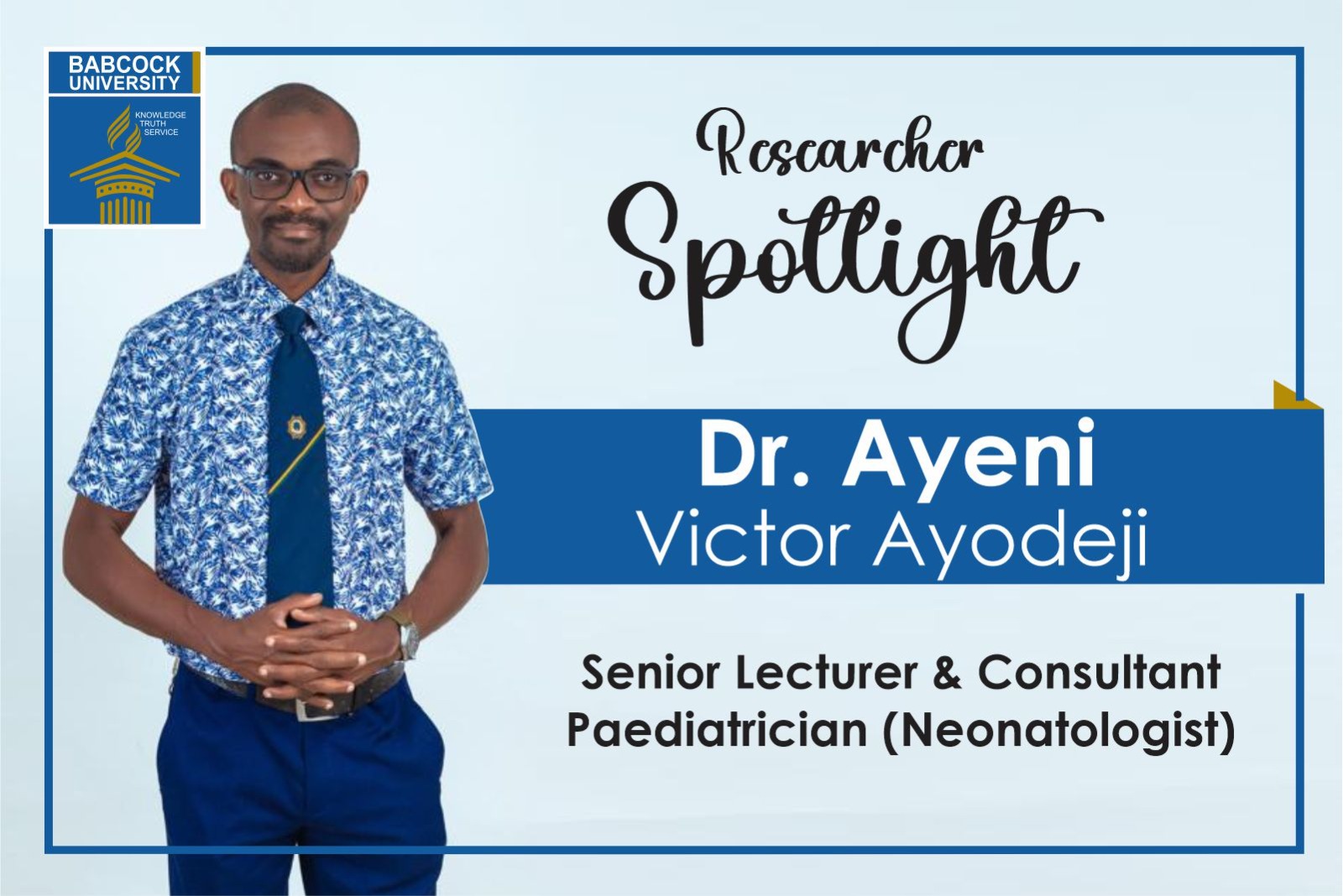
What if the key to protecting a newborn’s brain lies in understanding what happens inside the body before irreversible damage occurs? This question is driving Dr. Victor Ayodeji Ayeni’s research into perinatal asphyxia, newborn brain injury and foetal growth restriction, conditions that can threaten a child’s survival and long-term development.
A Senior Lecturer in Paediatrics at Babcock University and Consultant Paediatrician and Neonatologist at Babcock University Teaching Hospital (BUTH), Ayeni is investigating the biological processes behind these conditions and exploring potential interventions that could support earlier detection and more targeted, affordable care, particularly in resource-limited settings such as Nigeria.
In this edition of Babcock University Researcher Spotlight, Dr.Ayeni shares the motivation behind his research, what his published studies have revealed, and how his ongoing investigations could help shape the future of neonatal care.
1. What are you currently researching?
My research sits at the intersection of clinical neonatology and molecular biochemistry, focusing on translational neonatal medicine and the deciphering of cellular redox networks for neonatal neuroprotection and intrauterine foetal health. Specifically, I am investigating two major drivers of newborn vulnerability: neurodevelopmental hypoxic-ischaemic brain injury in asphyxiated neonates, and the endotoxin-driven failure of the maternal gut-placenta axis in Foetal Growth Restriction (FGR). Using N-acetylcysteine (NAC) as precision clinical mechanistic probes, my work seeks to systematically reprogram the NFE2L2 (NRF2) and RELA (NF-κB) transcriptional redox switch in vivo – activating the body's master antioxidant defences while suppressing destructive inflammatory cascades.
2. What problem inspired you to pursue this research?
Working at the cot-side as a Consultant Neonatologist, I am deeply concerned by the stark survival inequalities faced by newborns in Nigeria and other resource-restricted settings. Too often, critically ill neonates and growth-restricted foetuses suffer irreversible multi-organ and neurological damage before clinicians can intervene effectively. Furthermore, high-cost interventions used in high-income countries are frequently unavailable or less effective in our setting. This inspired me to seek solutions from a fundamental, mechanistic standpoint – characterising the upstream systemic failures that drive newborn mortality and long-term morbidity so we can equip clinicians with real-time diagnostic tools to direct organ-saving therapies before it is too late. I believe the Lord is leading me in this direction.
3. What have you discovered so far?
While the primary clinical and transcriptomic readouts from our ongoing multicentre trials are building up and will be declared in due course, my published work has already established critical baseline evidence for newborn care in Nigeria.
Our recent systematic review and meta-analysis of randomised controlled trials on pharmacologic neuroprotective agents in low- and lower-middle-income countries, published in PLOS ONE in 2025, highlighted critical regional inequalities and identified promising pharmacological directions to maximise the neurodevelopmental potential of Nigerian babies. This builds upon our earlier clinical outcomes research on neonates admitted with hypoxic-ischaemic and acute bilirubin encephalopathies in South-West Nigeria, published in South African Family Practice in 2019, which identified the key clinical and health-system determinants driving neonatal brain injury and mortality.
My research has also confirmed the physiological relationship between maternal and foetal micronutrients and how to optimise the postnatal development of Nigerian preterm babies. Across a three-part series, we established the relationship between maternal and preterm infant plasma Vitamin D levels at delivery, published in the West African Journal of Medicine in 2024; tracked the longitudinal trends in plasma Vitamin D levels across the first 10 weeks of exclusive breastfeeding, published by IntechOpen in 2025; and defined clinical frameworks for calcium, phosphate, magnesium, and Vitamin D metabolism in breastfed preterm babies, published in the Nigerian Journal of Paediatrics in 2024.
4. Why does this research matter beyond the university?
This research matters because newborn mortality and birth-related neurodisability remain urgent public health challenges in Nigeria and across sub-Saharan Africa. Rather than relying on expensive technologies that rarely reach secondary or rural facilities, my work is aims to develop precision-medicine approaches and affordable clinical interventions tailored at reducing birth-related brain injury, neonatal mortality, and long-term disability and foetal growth restriction. Because these findings are designed to be scalable and tailored to low-resource healthcare systems, they will directly inform hospital practice, health policy, and family well-being far beyond the university walls.
5. Who could benefit from your findings?
The beneficiaries of my research include critically ill and preterm neonates vulnerable to perinatal asphyxia and metabolic bone disease; pregnant mothers and unborn babies at risk of placental insufficiency and foetal growth restriction; clinicians and neonatal care teams in resource-restricted locations who need point-of-care diagnostics and accessible, organ-saving therapies; healthcare systems and policymakers across Africa and other low- and middle-income countries (LMICs) seeking evidence-based, cost-effective interventions to curb neonatal mortality; and researchers and postgraduate scholars working across neonatology, molecular biochemistry, and translational medicine.
6. What has your research journey taught you?
My research journey has taught me that uncovering the biological roots of foetal and newborn vulnerability requires looking beneath bedside symptoms through a multidisciplinary lens. The journey has shown me the power of purposeful collaboration across paediatricians, obstetricians, molecular biologists, public health clinicians/scientists, biochemists, chemical pathologists, biostatisticians, pharmacists and partner healthcare institutions. Above all, it has reinforced my conviction that translating fundamental molecular discoveries into practical, affordable clinical interventions is both achievable and essential for reducing death and disability in Africa.
7. If your research succeeds, what could change?
If this research programme succeeds, we could see a paradigm shift in managing perinatal asphyxia and foetal growth restriction (FGR) across Africa, moving from reactive supportive care to targeted molecular neuroprotection and placental rescue. We could also achieve early bedside risk stratification using validated, real-time point-of-care biomarkers to guide organ-saving therapies before irreversible brain damage occurs. Ultimately, this could lead to measurable reductions in neonatal mortality and long-term neurodisability, such as cerebral palsy, across Nigeria and comparable low-resource settings.
8. What are the next steps for your research?
The next steps for my research programme include completing our ongoing multicentre clinical trial by concluding our double-blind randomised controlled trial on the effect of N-acetylcysteine (NAC) on clinical outcomes of perinatal asphyxia across participating hospitals. We will also undertake transcriptional and biochemical profiling by quantifying gene expression and redox biomarkers in Ogun State neonates to establish baseline reference data and evaluate post-NAC treatment responses.
Another step is multi-omic data integration, which involves merging clinical metadata with quantitative reverse transcription polymerase chain reaction (qRT-PCR) and 16S rRNA next-generation sequencing to map maternal-foetal biological crosstalk. Finally, we will focus on biomarker translation and capacity building by translating bench discoveries into point-of-care diagnostic panels while contributing to the expansion of Nigerian capacity for biobanking, transcriptomics, and multicentre trials.
9. Relevance of your research to SDGs?
My research directly contributes to four United Nations Sustainable Development Goals (SDGs). SDG 3: Good Health and Well-Being is addressed through the development of affordable precision-medicine interventions to curb foetal growth restriction, birth-related brain injury, preventable newborn mortality, and long-term neurodisability. SDG 9: Industry, Innovation and Infrastructure is supported by strengthening domestic infrastructure for molecular diagnostics, ultra-low-temperature biobanking, transcriptomics, and multi-omics research in Nigeria.
My research also contributes to SDG 10: Reduced Inequalities by generating high-grade clinical trial evidence for scalable therapies tailored to low-resource health systems across Africa and other LMICs. In addition, SDG 17: Partnerships for the Goals is advanced through multidisciplinary alliances uniting clinical, molecular, and public health scientists across academic centres and state health agencies, including the Ogun State Hospitals Management Board.
10. Links to your publications?
- Victor Ayodeji Ayeni - Google Scholar
- https://orcid.org/0000-0002-8626-7181
- https://doi.org/10.1371/journal.pone.0337798
- https://doi.org/10.5772/intechopen.1010269
- https://pubmed.ncbi.nlm.nih.gov/39207936/
- https://doi.org/10.4314/njp.v51i2.01
- https://doi.org/10.4102/safp.v61i5.4938
- https://publication.babcock.edu.ng/profile/ayeniv