
| Sandra Ikegwuruka
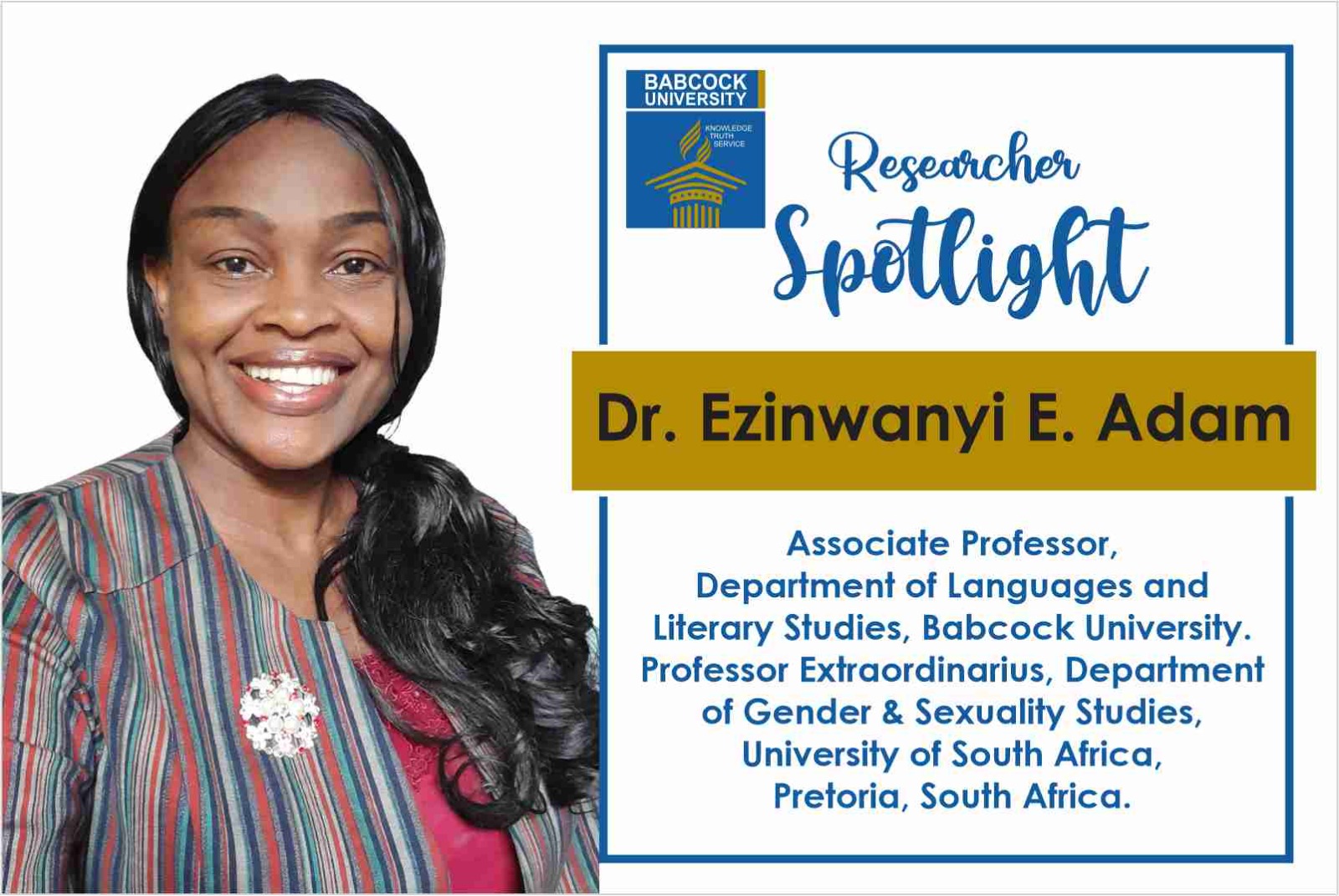
This Babcock University scholar discusses women's often-overlooked role in indigenous language preservation, African youth cultures, digital expression and the intersections of gender, power, public policy and sustainable development.
“Where African mothers preserve culture, and youth remix it – that is where I do my work.”
For Dr. Ezinwanyi E. Adam, this statement captures the central concerns of her scholarship: the preservation of African cultural heritage, the contributions of women to linguistic continuity and the ways young people reinterpret culture through digital expression.
An Associate Professor in the Department of Languages and Literary Studies at Babcock University, Dr. Adam is a scholar of Comparative Literature, African Studies and Gender Studies. She also serves as Professor Extraordinarius in the Department of Gender and Sexuality Studies at the University of South Africa, Pretoria.
Her research traverses indigenous language preservation, feminist language policy, African youth cultures and digital expressive traditions. Through a gendered and Africa-centred lens, her publications interrogate the intersections of gender, power, public policy and language, with critical interventions in African literature, digital culture and sustainable development.
In this edition of Babcock University Researcher Spotlight, she discusses her research interests, the importance of recognising women's linguistic labour, the cultural significance of digital expression and her ongoing efforts to advance gender-responsive indigenous language preservation in Africa.
THE INTERVIEW
Q: Your research cuts across Comparative Literature, African Studies, Gender Studies, language policy and digital cultures. What connects these seemingly different areas of scholarship?
My research focuses on the following: Gender and Sexuality Studies, Language and Public Policy, Digital Cultures and Youth Studies, Comparative Literature and African Studies, Sustainability and Social Justice.
My publications interrogate the intersections of gender, power, public policy and language, with critical interventions in African literature, digital culture and sustainable development.
Q: You place considerable emphasis on indigenous language preservation. Why is this an important area of research, particularly from a gender perspective?
My research trajectory directly advances the United Nations Sustainable Development Goals. It contributes to SDG 5 (Gender Equality) by exposing, amplifying and re-centring women's silenced voices and invisible labour as custodians of linguistic and cultural heritage.
My work recognises the role of women in sustaining indigenous languages and cultural knowledge, and seeks to make their often-overlooked contributions visible through a gender-responsive approach to preservation.
Q: You are developing a project titled Mothers of the Mother Tongue: A Gendered Critique of Public Policy and Indigenous Language Preservation for Sustainable Development in Africa. What is the central concern of this research?
The project examines indigenous language preservation through a gendered critique of public policy. It focuses on the role of African women as custodians of linguistic and cultural heritage and the need to recognise their contributions to sustainable development.
One of its key objectives is to propose a Gender-Responsive Indigenous Preservation (GRIP-Africa) Model.
Q: Your research also explores African youth cultures and digital expressive traditions. What does this area of scholarship seek to understand?
My recent co-authored work examines how Nigerian youth deploy recursive re-encoding of memes on digital platforms to resist inequality, document state failure, police brutality and electoral injustice, and negotiate gender norms.
Q: How do you understand the relationship between literature, cultural narratives and social development?
My work considers narratives, fictional and non-fictional, and literary texts – oral, print and digital – as sites for achieving inclusive, just and sustainable development in Africa.
These forms of expression provide important spaces for examining gender, power, cultural identity and social realities.
Q: Your research contributes to several Sustainable Development Goals. How do you connect your scholarship to these development priorities?
My research trajectory directly advances the United Nations Sustainable Development Goals.
It contributes to SDG 5 (Gender Equality) through its focus on women's silenced voices and invisible labour as custodians of linguistic and cultural heritage, as well as the proposed GRIP-Africa Model.
My work further addresses SDG 11.4 on the protection of cultural heritage, recognising indigenous languages as living cultural assets essential for sustainable communities.
My recent co-authored work also extends this impact to SDG 10 (Reduced Inequalities) and SDG 16 (Peace, Justice and Strong Institutions), particularly through its examination of Nigerian youth digital expression and resistance to inequality and injustice.
Q: Beyond academic discourse, who can benefit from the issues your research addresses?
My research addresses issues that concern women, young people, indigenous communities and the wider society. Its engagement with language preservation, gender-responsive public policy, cultural heritage and digital expression has relevance for conversations on inclusive development and social justice.
Q: Your academic journey includes several international research fellowships, grants and conference engagements. How have these opportunities featured in your scholarly development?
My academic engagements have taken me to several international research and conference platforms.
These include a research fellowship from the American Council of Learned Societies (ACLS) at the West African Research Centre in Dakar, Senegal, in 2016; a Catalyst Fellowship at the University of Edinburgh in 2019; and participation in the European Conference on African Studies in Edinburgh.
I also received a 100 per cent travel sponsorship from the German Research Foundation (DFG) to participate in the Association for African Studies in Germany conference at the University of Freiburg in 2022. More recently, I received travel grants to participate in the Diversity in Sexual Health Communication Conference at the University of Southern Denmark in April 2026 and the African Studies Association in Germany conference at the University of Basel in August 2026.
Q: You currently hold an appointment as Professor Extraordinarius at the University of South Africa. What does this appointment entail?
I am Professor Extraordinarius in the Department of Gender and Sexuality Studies, University of South Africa, Pretoria, South Africa. The appointment commenced on April 1, 2026, and runs until March 31, 2029, as a three-year renewable research associate position.
Q: What other research projects are you currently pursuing?
In addition to Mothers of the Mother Tongue, I am working on Spare Husband Syndrome, Sexual Health Discourse, and the African Woman's Dilemma, a monograph.
These projects reflect my continuing research interests in gender, sexuality, language, public policy and African women's experiences.
Q: How has Babcock University contributed to your academic and research journey?
Babcock University has been an important part of my academic journey. In 2023, I received the University's Vice-Chancellor's Faculty Research Award, presented to an outstanding researcher who embodies research excellence through talent, knowledge and expertise in their field.
The University also supported my participation in scholarly engagements, including the 2016 Toyin Falola Annual International Conference on Africa and the African Diaspora through the Babcock University Administrative Committee.
Q: What would you like readers to take away from your work on African women, cultural preservation and youth expression?
Where African mothers preserve culture, and youth remix it – that is where I do my work.
Q: Where can we find your work?
https://scholar.google.com/citations?user=Iu_cGlYAAAAJ&hl=en&oi=ao
Through the work of scholars such as Dr. Ezinwanyi E. Adam, Babcock University continues to demonstrate the value of research that engages contemporary African realities and contributes to conversations beyond national borders. Her scholarship reflects the University's commitment to advancing knowledge, promoting inclusive development and addressing societal challenges through rigorous, relevant research. By bringing African perspectives into global academic discourse, Babcock strengthens its position as a research-focused institution committed to shaping ideas, informing policy and making a meaningful difference in society.
Babcock University...Research That Matters. Scholarship That Shapes Society.